
《Hope》 (2026): Why Does It Leave You Scratching Your Head?
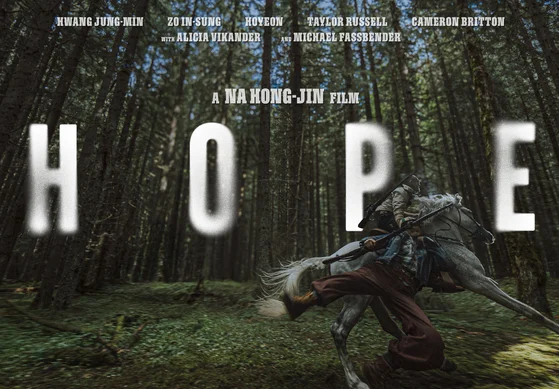
Director Na Hong-jin’s first film in 10 years, following The Wailing, has held on to the top spot at the box office after drawing more than 2.12 million moviegoers in its first five days.
With a production budget of 70 billion won, it is the most expensive Korean film ever made. Michael Fassbender and Alicia Vikander share the screen with Hwang Jung-min, Jo In-sung and Jung Ho-yeon. At the Cannes Film Festival, the film received a seven-minute standing ovation immediately after its competition screening. Up to this point, it looks like an undeniable success.
That kind of buzz makes the film worth seeing, if only to understand what all the excitement is about. I watched Hope today. But I found too many distracting flaws to write an unreservedly positive review.
Here is my candid assessment.
The Setup
The story takes place in the port village of Hopo Harbor, near the DMZ. It is the late 1970s or early 1980s, and the story begins when rumors spread that a tiger has appeared in the village.
As local outpost chief Beom-seok (Hwang Jung-min), tracker Seong-gi (Jo In-sung) and rookie police officer Seong-ae (Jung Ho-yeon) investigate the disturbance, it becomes clear that the creature is not a tiger but an extraterrestrial being.
The film is built around a small misunderstanding born of ignorance that grows into conflict within the community, before expanding into a catastrophe of uncontrollable proportions. Michael Fassbender and Alicia Vikander play Western characters entangled with the extraterrestrial presence. The married couple are appearing together on screen for the first time since 2016’s The Light Between Oceans.
What Works: The Power of the First Half
The film’s strongest section is obvious: its first hour. Several outlets, including Screen Daily, have compared the action in this stretch to Mad Max: Fury Road. That comparison is not entirely misplaced. This is where Na’s signature strengths—driving his characters relentlessly forward and steadily building tension—come through in their purest form.
That opening raised expectations for the middle and final acts. Unfortunately, those expectations gradually collapse.
Cinematographer Hong Kyung-pyo, who also worked on The Wailing, returns behind the camera, while the score comes from Michael Abels, a frequent collaborator of director Jordan Peele.
At least through the first half, I also agree with the positive reviews that the film keeps the audience engaged as it moves from mystery to action and black comedy.
The Problems That Need to Be Addressed
The trouble starts after that.
First, the VFX does not live up to a 70-billion-won production.
IndieWire, Variety and other outlets have repeatedly pointed out that the visual effects noticeably lose quality once the creature’s true nature is revealed.
Some critics have even said that the alien’s design recalls Attack on Titan. At that point, it is hard to dismiss the criticism as a matter of taste; the issue is the quality of the execution itself. The fact that the director was still working on the edit just four days before Cannes opened only reinforces that impression.
Second, was this really the best use of Michael Fassbender?
He appears throughout the film only as a CG-rendered extraterrestrial. It is a casting choice that erases the actor’s defining facial expressions and screen presence altogether. After hiring an actor of his stature, hiding his face from the audience makes it difficult to escape the impression that his name was used primarily as a marketing tool.
Third, the film tries to cram in too many genres.
The ambition to combine mystery, black comedy, war action and science fiction in a single film collides with a lengthy 160-minute runtime. As the story moves into its second half, one layer of exposition begins to bury another.
The repeated chases and battle sequences become exhausting. Early on, the police chief (Hwang Jung-min) is always one step behind as he pursues the monster—or alien. The villagers and pursuit teams, by contrast, move with such incredible speed that the scenes feel energetic but less believable. Then, after encountering the creature, the chief runs away at a speed that seems to exceed the monster’s.
I understand the intention: to use contrasting speeds to modulate the tension and pace of the story. But the film is so eager to include everything that the seams show.
Ambition is not a bad thing. The problem is that the screenplay was not sufficiently disciplined to contain all of it.
Fourth, the period details are underdeveloped.
The film is set in 1980s Korea, yet there is not a single farmer in sight, and the deserted streets—without even a vehicle passing through—never quite lose their artificial, backlot feel.
Scene after scene also raises the question of why the story had to be set in this particular period. The sets feel conspicuously constructed, as though the production is trying too hard to make them look deliberately artificial.
In a big-budget film, details like these determine how deeply the audience can immerse itself. This is one area where Hope falls short.
The two opposing reactions—“the best action film of the year” and “a film ruined by some of the worst special effects”—are, in fact, both understandable.
The gap between the film’s command of its first half and the quality of its second is so wide that it is hard to believe they belong to the same movie.
The aliens’ conversations late in the film are, frankly, baffling intrusions that seem to come out of nowhere.
Why suddenly give the aliens’ dialogue a lyrical, sentimental quality near the end? For the entire film they have been merciless, violent beings bent on wiping out humanity—only to start acting compassionate all of a sudden?
It is an almost impossible turn to understand. Perhaps this is meant to set up a sequel, but even that foreshadowing is so clumsy that it is difficult to make sense of.

What the Film Is Saying to Us Now
There is something easy to miss if Hope is treated as nothing more than a creature feature.
Director Na has said that the film began with “the ominous nature of the world.” In practice, its central structure is not the monster itself but the misunderstandings and conflicts that humans create around it.
A single false rumor about a tiger pushes the community to the brink of collapse. Along the way, distrust and fear of one another create a greater disaster than the genuine threat.
This is hardly an unfamiliar story. Rumors spread before information can be verified; those rumors divide people into opposing camps; and the camps harden into mutual hostility. The pattern is not very different from what we witness every day online, in the news and even in ordinary conversation.
The DMZ setting is equally significant. The region remains locked in an unresolved standoff, carrying the constant tension that a misunderstanding or miscalculation could turn into a real confrontation at any moment. That tension is much closer to the heart of what the film is trying to say beneath its science-fiction surface.
The message of Hope is not grand or uplifting. If anything, it is the opposite: an uncomfortable reminder of how quickly ignorance and fear can become collective madness—and that the only thing capable of stopping that transformation may be the clear-headed judgment of individuals.
There is an irony, and perhaps a deliberate provocation, in the fact that a film titled Hope is ultimately about the process by which hope collapses.
Jo In-sung Makes Rags Look Good
In any case, turning the shabby clothes of a country farmer into something that looks incredibly stylish—if not quite couture runway material—is a talent in itself. That is exactly what Jo In-sung manages to do in this film.
Being handsome and tall certainly helps.
My overall reaction to the film is full of question marks.
Still, the occasional flashes of black comedy and the performance of the energetic young police officer Im Soon-kyung add to the film’s entertainment value.
I find myself wondering how other viewers will respond to this controversial film.
Verdict — 3.5/5
Judged purely on execution, the film has obvious flaws. Spending 70 billion won and still delivering VFX that fall short of expectations is disappointing, while casting an actor like Fassbender and barely showing his face is an indefensible misstep.
Even after acknowledging all of those shortcomings, however, I believe the film’s command of its first half and the central concern it tries to explore—the way ignorance and rumor can become a catastrophe—make it worth seeing in a cinema.
It is not a perfect film. But a movie that takes bold risks, succeeds decisively in some areas and fails conspicuously in others is more memorable than one that is merely competent. Like a film that gambled 70 billion won, Hope asks its audience not simply to like or dislike it, but to make a judgment.
Frequently Asked Questions (FAQ)
Q1. Is Hope a horror film or a science-fiction film?
Its official genres are science fiction, action and thriller. In practice, though, it is closer to a hybrid that moves through mystery, black comedy, war action and science-fiction creature horror. Viewers expecting a single, clearly defined genre may find it disorienting.
Q2. Do Michael Fassbender and Alicia Vikander have substantial roles?
They play Western characters, but the story centers on the Korean characters portrayed by Hwang Jung-min, Jo In-sung and Jung Ho-yeon. Fassbender, in particular, plays an extraterrestrial created through CGI, so his actual face is rarely seen. This is also the first time the two actors have appeared together since 2016’s The Light Between Oceans. Anyone expecting major screen time based solely on their names may be disappointed.
Q3. The runtime is long. Is the film boring?
At 161 minutes—two hours and 40 minutes—it is undeniably long. The first hour moves briskly, but many viewers may find that the pace slows in the second half as more and more plot elements are introduced. Those who arrive expecting a straightforward action film may feel particularly fatigued by the final stretch.
Q4. Is it suitable for children?
The film is rated for viewers aged 15 and older. It contains violent scenes and disturbing creature imagery, so it is not recommended for viewing with young children.
Q5. Which format is best for seeing the film in theaters?
The film is screening in a range of formats, including 2D, IMAX, SCREENX, 4DX and Dolby Cinema. If you want to experience the scale and sound of the action sequences in the first half, a large-format presentation such as IMAX or Dolby Cinema is the better choice. However, because the VFX have been widely criticized for their inconsistency, keep in mind that a larger screen may also make those shortcomings more noticeable.
