
The Bottom Line: Gladiator Isn’t a Perfect Film—It’s a Film That Works Perfectly

There are a handful of films that draw me in so completely that I feel as if I’ve stepped through the screen.
Ridley Scott’s 2000 film Gladiator remains a masterpiece that gets my heart racing more than 25 years after its release. It is widely regarded as a fine film—and is also one of the few Hollywood classics that continues to invite serious debate.
The film grossed $466 million worldwide and received 12 Academy Award nominations, winning five, including Best Picture and Best Actor for Russell Crowe.
According to Rotten Tomatoes, 80 percent of 260 critics gave it a positive review, with an average score of 7.1 out of 10. In other words, the film achieved overwhelming success by all three measures: box office performance, awards recognition and enduring public affection.
And yet discussion of the film has long split into two opposing camps.
One side calls it “a sweeping masterpiece.” The other dismisses it as “a historically inaccurate film with childish dialogue.”
This essay will not split the difference or try to appease both sides. Put bluntly, the two main criticisms of Gladiator—(1) its failure of historical accuracy and (2) the criticism, most famously voiced by Roger Ebert, that its screenplay and dialogue are juvenile—are, as matters of fact, largely correct.
But those criticisms do not diminish the film’s achievement, because they judge it by the wrong standards.
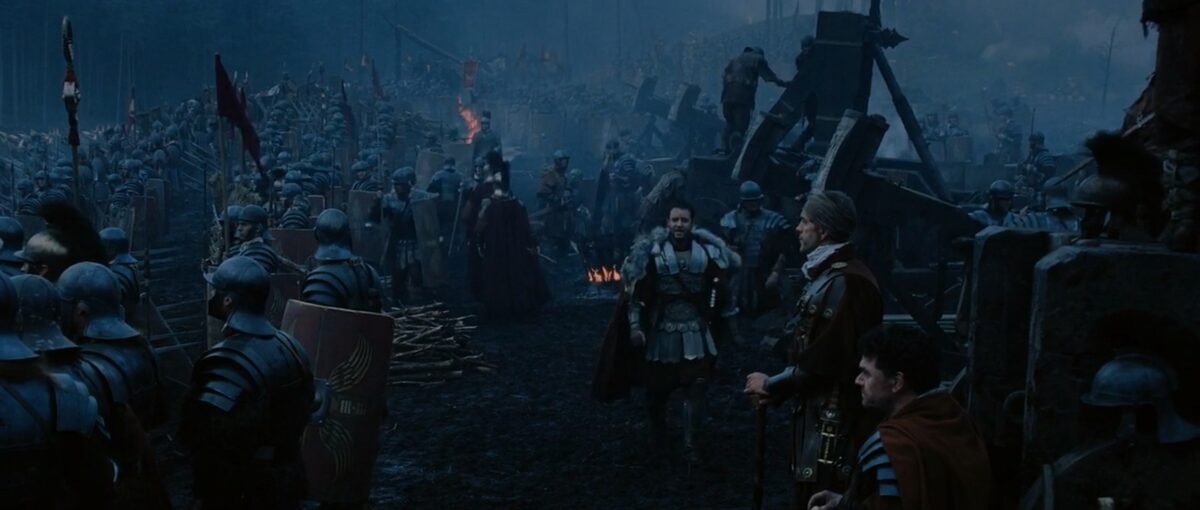
Gladiator is not a documentary. It is a myth, and judged by the grammar of myth, its construction is almost impossible to fault. That is the central argument of this essay.
The Story: Bringing The Count of Monte Cristo to Rome
In A.D. 180, Roman general Maximus Decimus Meridius (Russell Crowe) leads Rome to victory in its war against the Germanic tribes and earns the trust of Emperor Marcus Aurelius (Richard Harris).
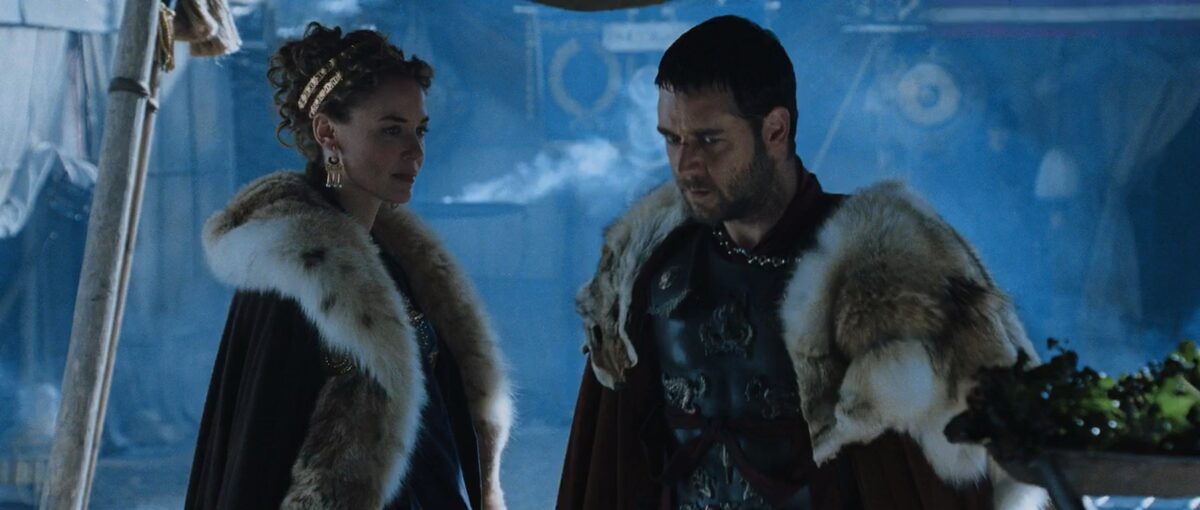
The emperor intends to pass the throne not to his biological son, Commodus (Joaquin Phoenix), but to Maximus. When Commodus realizes this, he kills his father, takes the throne and attempts to have Maximus and his family murdered.
Maximus escapes, but loses his wife and son. Sold into slavery, he is trained as a gladiator under the promoter Proximo (Oliver Reed), eventually facing Commodus in a final showdown at the Colosseum.
Many critics have compared this structure to Alexandre Dumas’s The Count of Monte Cristo, and the comparison is entirely justified.
A peaceful life is taken away, the hero is brought to the lowest possible point, and then rises back to the top in pursuit of revenge. It is one of the most proven story structures in Western popular fiction, and Gladiator transfers that structure with precision into the genre of the Roman gladiator film.
The Film Succeeded Because of Its Design, Not Its History
1) The Timing of the Genre’s Revival
After the enormous production costs of Cleopatra failed to pay off in 1963, followed by the box-office disappointment of The Fall of the Roman Empire in 1964, Hollywood stayed away from large-scale Roman epics for nearly 40 years.
Gladiator was the first film to break that silence, and that alone generated considerable attention.
The subsequent run of epic films set in the ancient and medieval worlds—including Troy (2004), Kingdom of Heaven (2005), Alexander (2004) and 300 (2006)—was possible because Gladiator demonstrated that the genre could still survive commercially.
Its success, then, was not merely a one-off hit. It reignited an entire genre cycle.
2) Clear Character Design
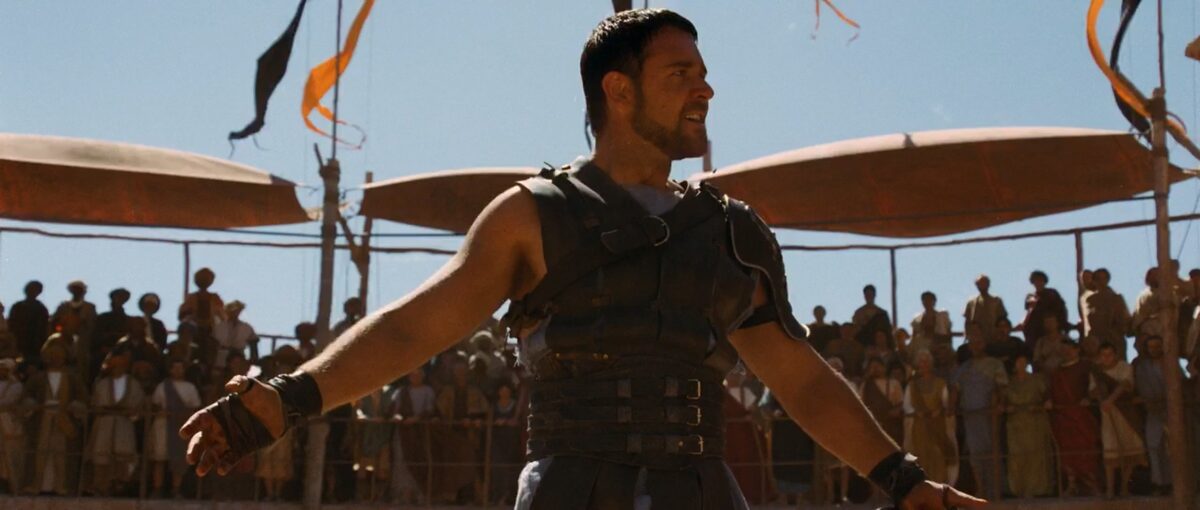
Maximus is not a complicated character. In fact, he is the opposite. He is driven by a simple, unwavering set of traits: loyalty, discipline, love of family and a burning desire for revenge.
That simplicity is not a flaw but a strategy. Audiences can remain emotionally engaged throughout the film’s runtime of more than two hours because the protagonist’s motivation never becomes unclear.
By contrast, Joaquin Phoenix portrays Commodus as a layered villain, a volatile mixture of weakness, emotional deprivation and inferiority.
That contrast—simple, straight-line goodness set against complex, twisted evil—is the engine that keeps the drama taut from beginning to end.
3) The Physical Conviction of Its Spectacle
The criticism that some of the CGI looks crude by today’s standards—particularly in distant views of the Colosseum—is fair.
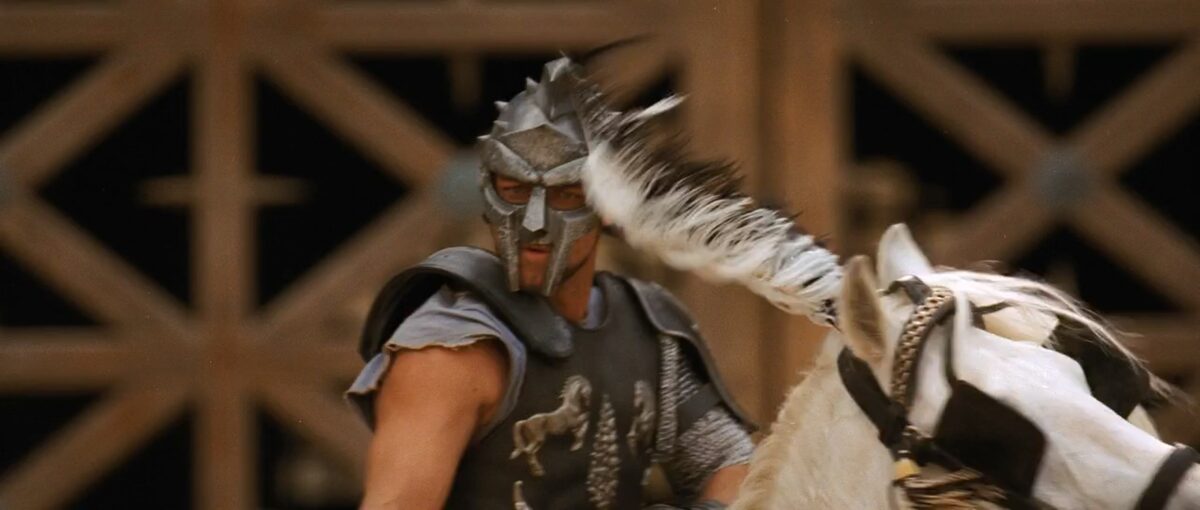
But the physical choreography of the gladiatorial combat remains convincing.
Production stories about the sword-and-axe clashes being mapped out in 40 pages of storyboards and rehearsed every day for three weeks show how Scott approached action not as mere style, but as physical reality.
The dangerous shooting methods used in the tiger fight—so hazardous that a performer was actually injured—still convey a visceral sense of physical tension to audiences living in the age of CGI.
4) Hans Zimmer’s Score
It is easy to overlook, but Hans Zimmer’s score, enriched by Lisa Gerrard’s vocals, is central to defining the film’s emotional tone.
Even when the dialogue feels exaggerated or contrived, the music fills the emotional gaps. It is decisive in unifying the film’s overall tone as one of “majestic tragedy.”
Criticism No. 1: “The Screenplay Is Juvenile”—Was Roger Ebert Right?
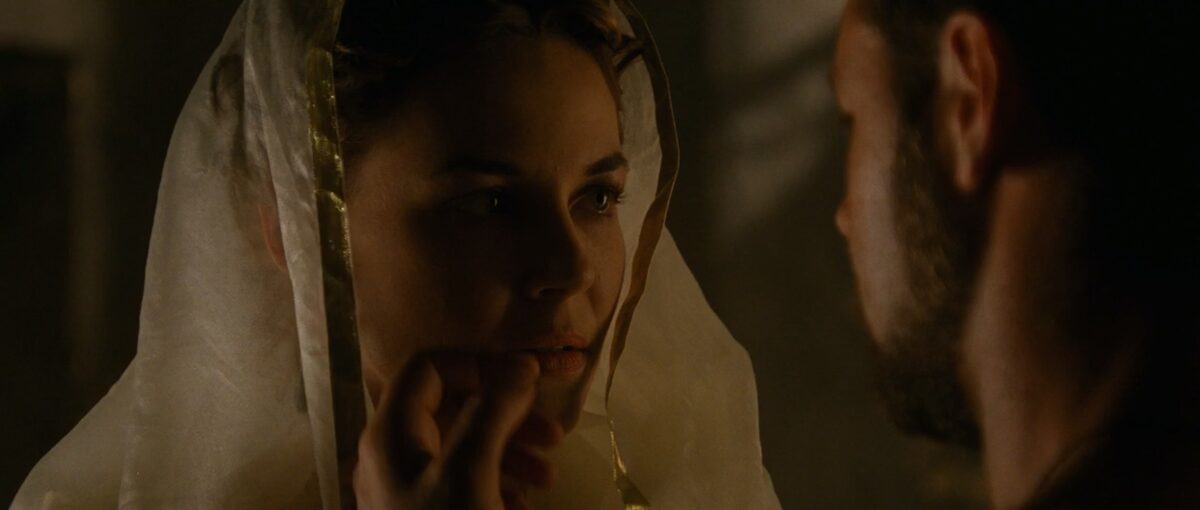
Roger Ebert gave the film two stars out of four, criticizing its “murky, muddy” images, saying the Colosseum looked “like a model in a computer game,” and arguing that its characters were merely miserable and depressed rather than entertaining.
He called the film “Rocky in a down mood” and took issue with the predictability of its story.
Ian Nathan of Empire likewise described the dialogue as “grandiose, overblown and often laughable,” while political scholar Michael Parenti criticized the film in his book for reducing Roman citizens to a bloodthirsty mob.
These criticisms are not factually wrong.
Lines such as “I will have my vengeance, in this life or the next” can indeed sound contrived when examined closely, and the broad outline of the story is predictable.
But this is where we need to be clear-eyed.
Ebert judged the film against traditional epics such as Spartacus and Ben-Hur, and by that standard Gladiator may look somewhat diminished.
Yet when we consider its popular success, critical reception and cultural staying power a quarter-century later, the fact that Ebert’s view remained a minority opinion is itself revealing.
That 80 percent of the 260 critics listed by Rotten Tomatoes responded positively suggests that Ebert’s judgment was closer to a matter of personal taste than an industry-wide consensus.
The criticism that it is a “predictable revenge story” is valid. But for that predictability to count as a flaw, one would have to reject the very reason the mythic revenge story exists. Myths repeat familiar structures in order to produce catharsis.
By that measure, predictability is not a defect but evidence that the film has fulfilled its genre.
Criticism No. 2: Historical Distortion—Is the Film “Fake History”?
Historians’ objections are far more specific and wide-ranging than the complaints about the screenwriters’ imagination.
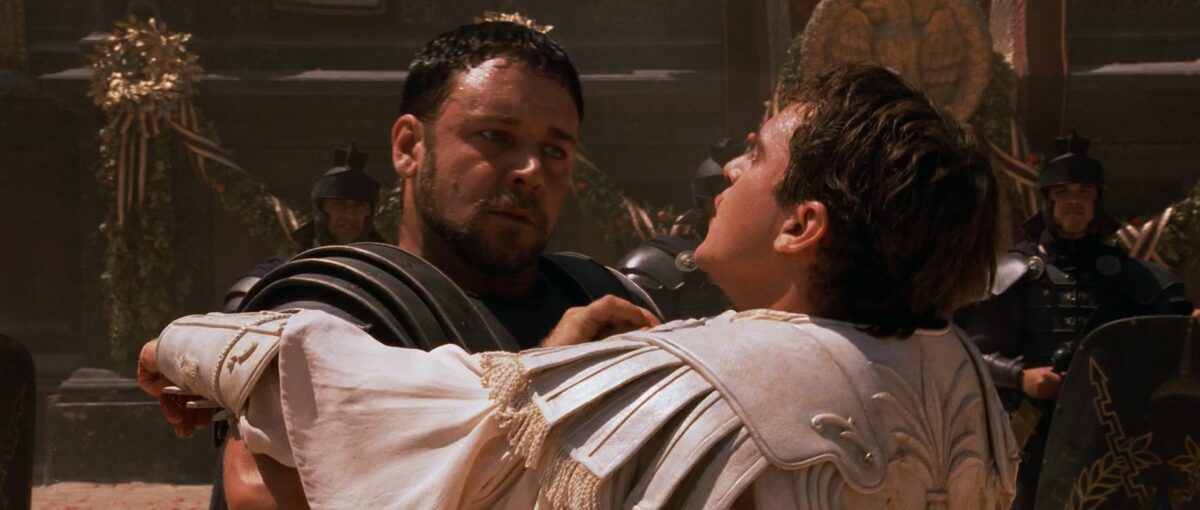
Marcus Aurelius was not assassinated by Commodus. He died of natural causes around A.D. 178–180, most likely from the Antonine Plague, which is generally believed to have been smallpox or measles.
There is also no historical basis for the idea that he wanted to restore Rome as a republic; Rome had already become an imperial system after 27 B.C.
Unlike the film’s portrayal, Commodus was handsome and hedonistic. In reality, he was obsessed with gladiatorial combat, fighting in the Colosseum himself with a wooden sword and carrying out massacres by disguising disabled people as wild animals to be hunted. He was considerably more brutal than the film suggests.
He was actually killed by a wrestler named Narcissus, and Maximus himself never existed.
His sister Lucilla, meanwhile, was discovered plotting her brother’s assassination, exiled to Capri and eventually executed. The film omits this tragic conclusion.
There is no need to dispute these points. They are all true.
Ridley Scott hired several historical advisers, but one resigned in protest over the direction of the adaptation, while another reportedly asked not to be credited.
Even so, the point that must be made clearly is that Scott and his production team never sold this film as a “documentary reconstruction.”
As University of Connecticut historian Allen Ward observed, it is fair to argue that a higher level of historical accuracy would not have made the film less interesting. At the same time, the film was designed not as a “film based on a true story,” but as fiction inspired by real people and a historical period.
Maximus is a composite character assembled from fragments of several historical figures, including the real general Taruttienus Paternus, the wrestler Narcissus who killed Commodus, and Tiberius Claudius Pompeianus, a general of humble origins who won the favor of Marcus Aurelius.
In other words, the film’s historical inaccuracies are not mistakes but design choices.
It did not fail because it mishandled history. It deliberately used history as raw material to create a new myth.
Miss that distinction, and the criticism itself is aimed in the wrong direction.
The Clear-Eyed Final Verdict: How Should We Judge This Film?
Here is the short version. If you judge Gladiator as “a sophisticated epic in the tradition of classical Roman cinema,” then Ebert’s harsh assessment begins to look justified.
The dialogue is overblown, the plot is predictable and the CGI has aged. If you judge Gladiator as a depiction of the actual late Antonine dynasty, then the historians’ criticisms are all correct.
Marcus Aurelius’s death, Commodus’s personality and the character of the Senate all differ from the historical record.
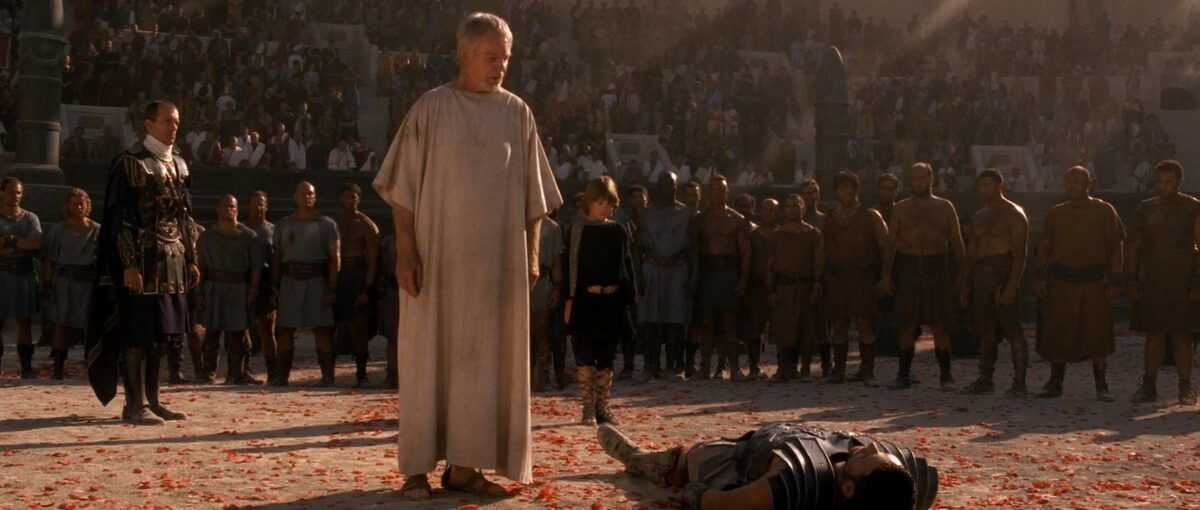
But judge Gladiator as a modern myth that transplants the archetypal story of revenge into the world of gladiatorial combat, and the picture changes completely.
By that standard, everything becomes an achievement rather than a flaw: the protagonist’s simple, lucid motivation; the predictable but precisely engineered revenge plot; the symbolic characters assembled from historical materials; and the action direction grounded in physical conviction.
The fact that the film ranked 92nd on The New York Times’ list of the 100 best films of the 21st century and 39th on Empire’s list of the 100 greatest films of all time—and that it retained enough cultural vitality to inspire the sequel Gladiator II 24 years after its release—shows how audiences ultimately remembered it: not as accurate history or a flawless screenplay, but as a well-designed myth.
The conclusion, then, is clear.
Most criticisms of Gladiator are factually justified, but they do not invalidate the film’s achievement.
That is because they judge the film by standards unrelated to what it set out to do in the first place—historical reconstruction or literary dialogue-driven drama.
Measured by the grammar of myth—a simple moral divide, a predictable but intensely cathartic revenge narrative, and symbolically constructed characters—Gladiator does its job almost flawlessly.
“Not a perfect film, but a film that works perfectly” is what the phrase at the beginning of this essay is meant to capture.
Frequently Asked Questions (FAQ)
Q1. Is Gladiator based on a true story?
No. Maximus is not a historical figure. He is a fictional character assembled from traits associated with several real Roman generals and gladiators, including Taruttienus Paternus and Narcissus, the wrestler who killed Commodus. The period and historical emperors such as Marcus Aurelius and Commodus are drawn from real history, but most of the specific events were adapted or invented.
Q2. Why did Roger Ebert give the film a low rating?
Ebert criticized the film’s dull color palette, crude special effects and characters who, in his view, relied too heavily on tragic emotion without enough individuality. He gave it two stars out of four, making his review a minority opinion compared with the 80 percent positive rating among Rotten Tomatoes critics.
Q3. What is the biggest historical distortion in Gladiator?
The most significant distortion is the claim that Marcus Aurelius was assassinated by his son Commodus. In reality, he died of natural causes around A.D. 180, most likely from an epidemic. The idea that he wanted to restore Rome as a republic also has no historical basis.
Q4. Why was Gladiator acclaimed enough to win Best Picture?
Its success came from a combination of clear character motivations, action direction with physical conviction, the emotional unity created by Hans Zimmer’s score and the timely revival of the Roman epic after a gap of nearly 40 years. It won five awards from 12 nominations, including Best Picture and Best Actor.
Q5. What should first-time viewers pay attention to?
Rather than approaching it as a historically accurate account, focus on how the archetypal story of revenge is structured mythically through the setting and genre of gladiatorial combat. If you treat the exaggerated dialogue and predictable plot as genre conventions rather than defects, the film’s strengths become much clearer.
