
Classics Are Never Forgotten
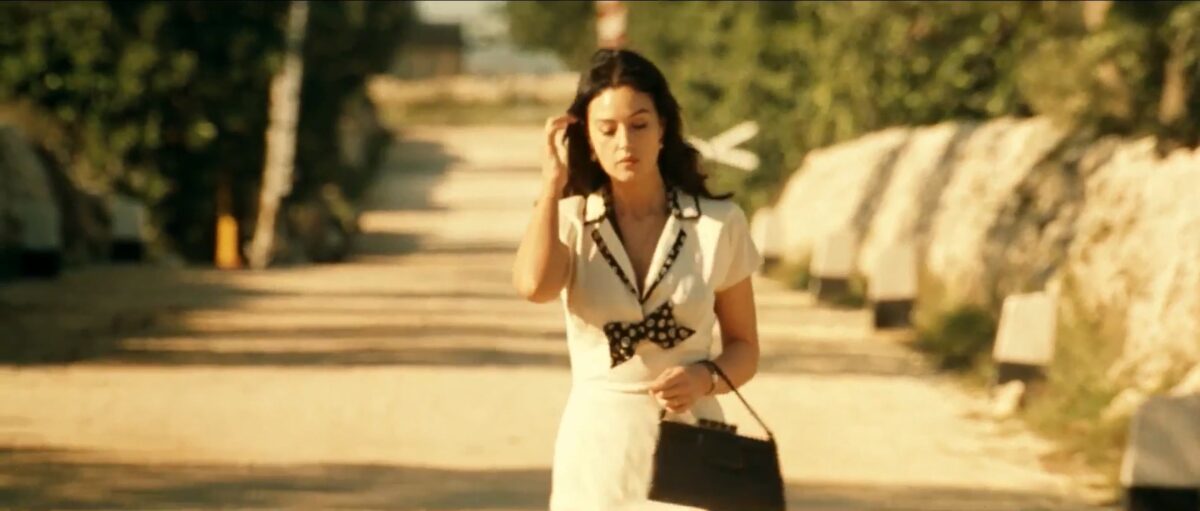
Giuseppe Tornatore’s 2000 film Malèna is a masterful examination of the collective madness of a community and the stark face of fascism lurking beneath the Mediterranean sun and the breathtaking beauty of Sicily.
The film has remained a subject of discussion in world cinema decades after its release, thanks to the commanding presence of its star, Monica Bellucci, and the lyrical yet mournful score by the great Ennio Morricone.
🎬 Malèna: Key Facts and Narrative Structure
1. Overview and Creative Team
- Director/Screenwriter: Giuseppe Tornatore (Cinema Paradiso, The Legend of 1900, The Best Offer, among others)
- Based on: A short story by Luciano Vincenzoni
- Cast: Monica Bellucci as Malèna; Giuseppe Sulfaro as Renato
- Music: Ennio Morricone
- Cinematography: Lajos Koltai
- Release year: 2000 (Italy/United States)
- Major awards and nominations: Nominated for Best Cinematography and Best Original Score at the 73rd Academy Awards; nominated for Best Foreign Language Film and Best Original Score at the 58th Golden Globe Awards
2. Synopsis
It is 1940, in the midst of World War II. In the small Sicilian town of Castelcutò lives Malèna, a beautiful woman who captivates every man in town and becomes the object of every woman’s jealousy.
Her husband, Nino, has been away fighting on the North African front ever since shortly after their wedding.
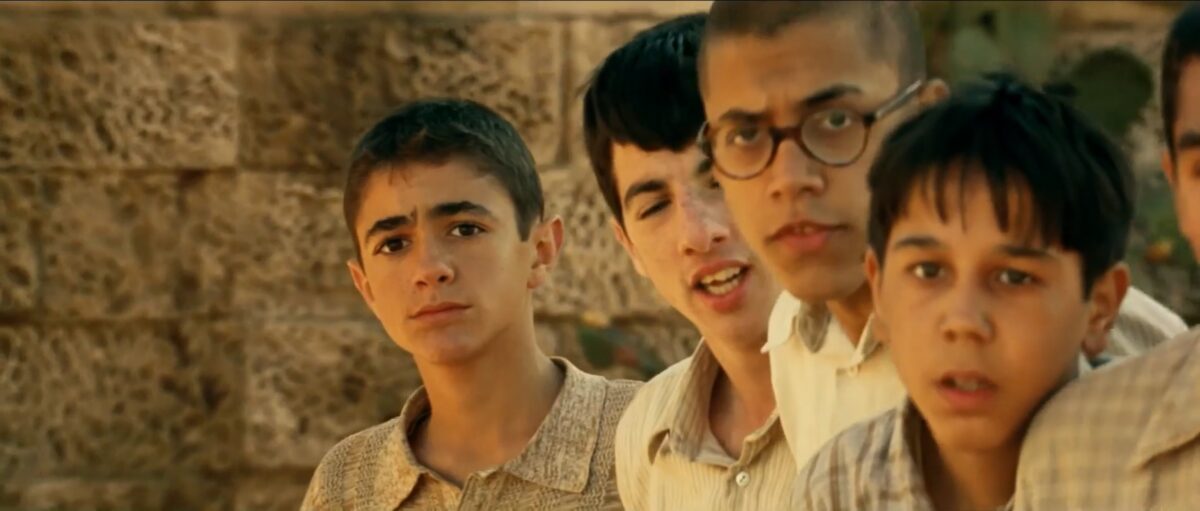
Renato, a boy who has just turned 13 and is entering puberty, is struck by a consuming infatuation the moment he sees Malèna walking through the town square.
He follows her on his bicycle and watches her every move through the window of her house at night, making love to her in his imagination.
Tragedy arrives as the war intensifies.
When false news spreads that Malèna’s husband has been killed, the men of the town descend on her with the lust of people eyeing legitimate prey. At the same time, wary of their wives, they refuse to offer her respectable work. To make matters worse, her hard-of-hearing father, deceived by the town’s malicious gossip, turns his back on his daughter and dies in a bombing raid.
With no one left to turn to, Malèna fights for survival in court, only to have her lawyer demand her body in lieu of payment.
When German forces occupy the town, hunger and oppression finally drive Malèna to cut her hair short, dye it red and become a prostitute who sells smiles to German soldiers.
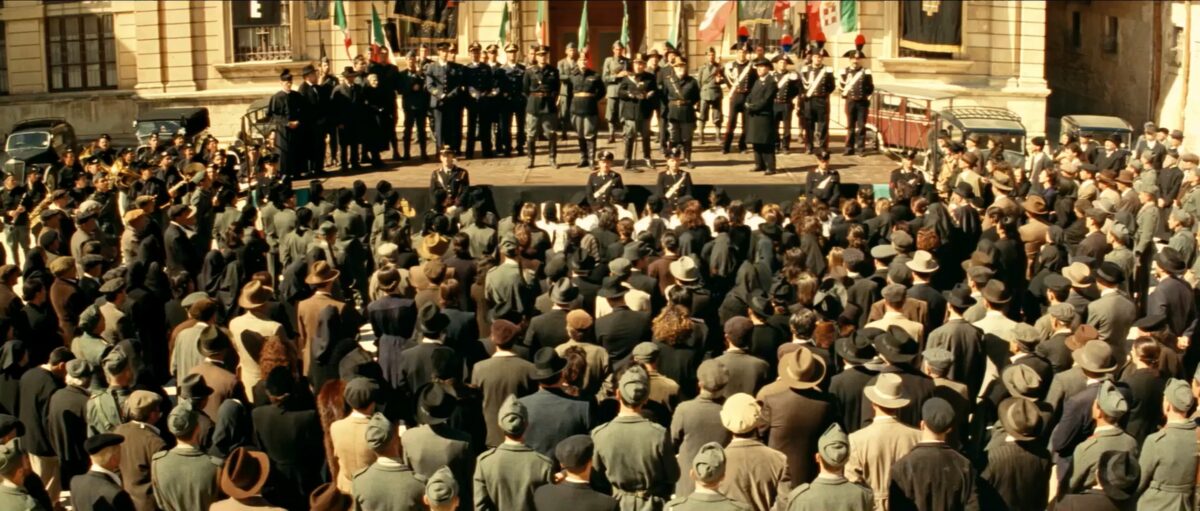
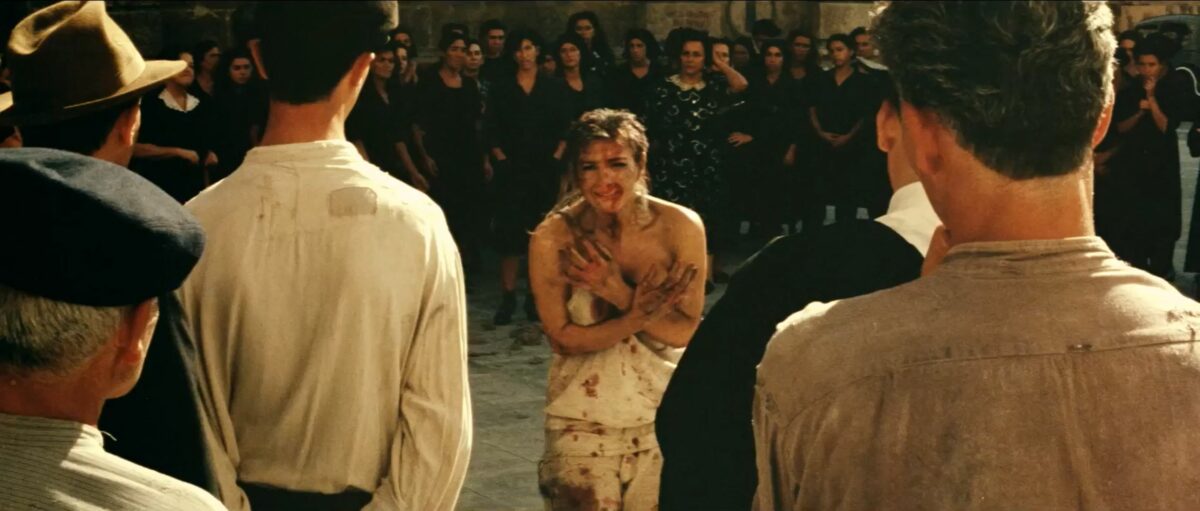
At last, the war ends and the Allied forces arrive. The women of the town, their resentment long suppressed, drag Malèna into the square, beat her collectively and tear at her hair, punishing her for her “beauty.” Bloodied and screaming, Malèna leaves town, while only Renato watches the tragedy through his tears, a powerless bystander.
A year later, Nino—believed to be dead—returns to town disabled, having lost one arm.
As the townspeople mock him, Nino searches for his wife. Renato sends him an anonymous letter revealing where Malèna has gone and telling the truth about how he alone tried to protect her honor.
Eventually, the couple return to Castelcutò.
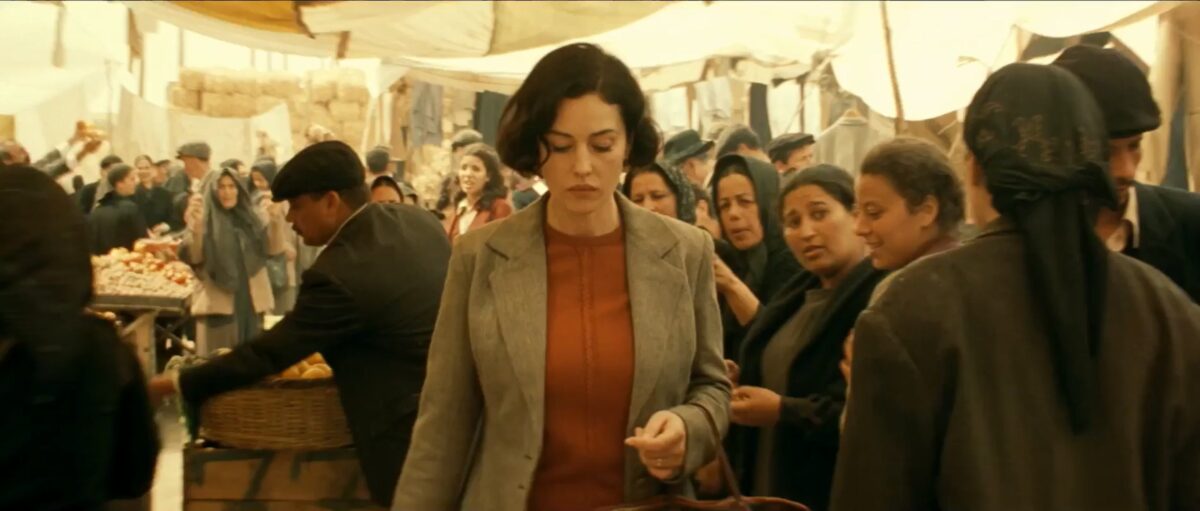
Now with wrinkles around her eyes and a fuller figure—no longer “threatening,” just an ordinary middle-aged woman—Malèna is finally greeted by the town’s women as an equal neighbor: “Buongiorno.”
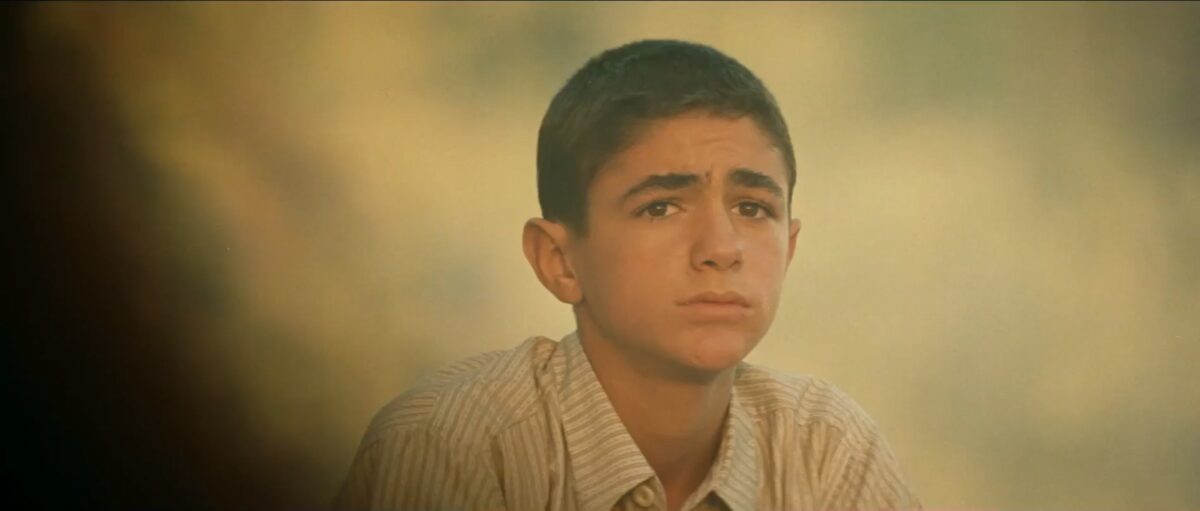
After picking up fruit Malèna has dropped, Renato speaks with her briefly for the first time. As he watches her walk away, he confesses that although he would meet countless women over the course of his life, the one name he could never forget was Malèna’s. The film ends.
💬 Critical Response and Analysis at Home and Abroad
Critics and audiences have responded to Malèna in markedly different ways. Its reputation is layered and often sharply divided depending on the era and the perspective from which it is viewed.
🔴 Negative and Critical Views: “Voyeuristic Framing and Sentimental Clichés”
- Roger Ebert and other mainstream North American critics: At the time of its release, some Western critics accused Tornatore’s direction of being overly melodramatic and packed with clichés. Roger Ebert, in particular, argued that the film fell short of the rich, refined lyricism of Cinema Paradiso and used the sexual fantasies of an adolescent boy as a pretext for consuming Monica Bellucci’s body through a deeply voyeuristic male gaze.
- A lack of agency: Others have noted that Malèna has very little dialogue throughout the film and remains a “passive victim and sexual symbol,” defined almost entirely by the gazes and distortions of others—a portrayal that can feel troubling from a contemporary perspective.
🟢 Positive and Revisionist Views: “A Scathing Indictment of Human Nature and Collective Madness”
- Reversing the gaze and criticizing fascism: Contemporary film commentators, including an analysis on Reddit’s TrueFilm forum, have reevaluated the film as more than a coming-of-age story. They see it as a political text dissecting how the public gaze can operate as violence and fascism. The light, comic voyeurism of the early scenes encourages viewers to identify with the boy’s perspective; by the time the film reaches the violent square sequence, however, viewers are forced to confront the “violence of the gaze” they themselves have participated in, creating a profound ethical shock.
- The nature of female envy: The women’s collective assault is not reduced to the simplistic idea that “women are women’s worst enemies.” Instead, the film is praised for portraying it as an eruption of fear and envy directed at the “sexual capital” of a woman whom established women, forced to depend on male power under patriarchy and fascism, perceive as a threat to their own basis of survival—their families.
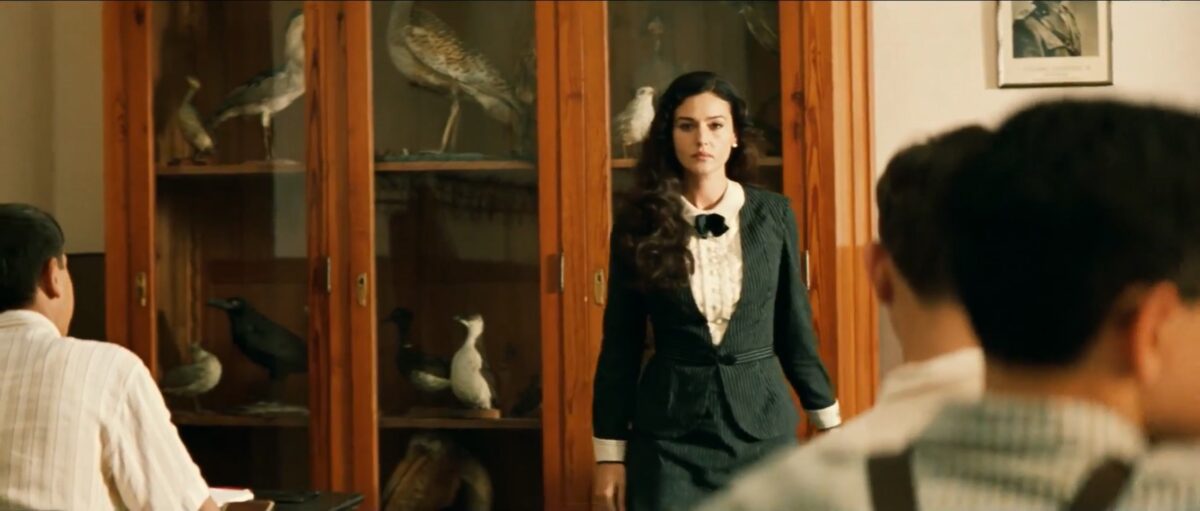
✍️ Overall Review: The Hell of the Gaze and the Flesh of Fascism
Introduction: The Gray Abyss of Human Nature Beneath the Mediterranean’s Golden Sun
Giuseppe Tornatore’s camera is always drawn to places shaped by memory and loss.
If his monumental 1988 masterpiece Cinema Paradiso used the glow of a projector to send a love letter to childhood innocence and the movies, his 2000 film Malèna is a cold indictment of the ugliness and collective madness lurking behind that innocent age.
Castelcutò in Sicily, captured by Lajos Koltai’s camera, looks like paradise: golden sunlight, a white marble square and the blue Mediterranean.
Yet as the film progresses, this perfectly composed setting turns into a vast psychological prison—and a slaughterhouse where a single innocent woman is torn apart.
On the surface, Malèna follows the coming-of-age story of an adolescent boy experiencing sexual awakening. At its core, however, it is a searching account of how the everyday weapon known as the gaze can ally itself with vast political violence—fascism—and destroy a human being.
Part One: The Male Gaze and the Dilemma of Objectification
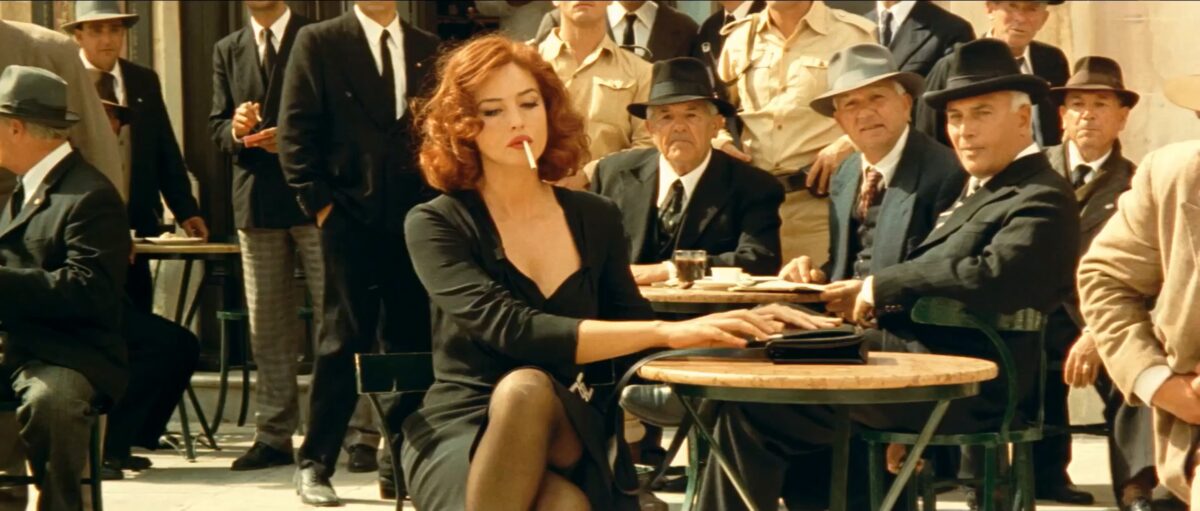
The film’s central focus is unmistakably Malèna’s body and the way she walks, as played by Monica Bellucci. When she crosses the square in black mourning clothes, the camera adopts the perspective of Castelcutò’s residents and the boy Renato. The click of her heels, the hem of her skirt moving in the breeze and the camera’s lingering movement along the curves of her body are all clearly rooted in the “male gaze.”
Some critics have condemned the director for stimulating the audience’s voyeurism and objectifying a woman. Paradoxically, however, the film’s achievement lies in pushing that process of objectification to its extreme, then returning it to the audience as an ethical boomerang.
Malèna hardly speaks throughout the film. In the space where her voice has been silenced, the townspeople forcefully project their own desires and insecurities.
To the men, she is simultaneously an exalted “Madonna,” expected to remain faithful while her husband is away at war, and the object of a contrasting fantasy: a “whore” they would like to pull into their beds at any time.
This gaze is never innocent.
The men do not see Malèna as a dignified human being. They treat her as the highest form of “sexual capital” to be acquired and as a trophy in a patriarchal society.
Her beauty becomes a kind of divine punishment rather than a blessing, and the fact that not one man—whether in court or on the street—is willing to offer her genuine support exposes the vicious hypocrisy of a patriarchal society.
Part Two: How Fascism Works and the Violence of Everyday Life
The fact that Malèna is set during World War II and Mussolini’s fascist regime takes the film beyond the confines of a simple melodrama or coming-of-age story.
Early in the film, Mussolini’s declaration-of-war speech rings grandly from a radio, and the crowd in the square erupts in a frenzied cheer.
Through his direction, Tornatore demonstrates that the madness of state fascism and the collective ostracism and violence directed at Malèna by the people of Castelcutò spring from essentially the same roots.
Fascism inevitably needs a “scapegoat” to cement internal solidarity. Malèna, an outsider who has lost the protection of patriarchy after her husband is reported killed, becomes the most vulnerable and perfect target for a community worn down by war, fear and hunger.
The brutality of the town’s women is especially painful, showing how the weak can be made to oppress the weaker under fascism.
The women shift onto Malèna the blame for their husbands’ lustful gazes.
Groundless accusations and rumors—that “she seduced them” or that “she is a public menace”—snowball through popular ignorance until reason is overwhelmed.
The square’s collective assault after the war, directed at Malèna because she was forced to sell her body to survive under the German occupation, is the film’s emotional peak and its most hellish moment.
As Malèna’s clothes are torn, her hair cut away and her body left bleeding, her screams make painfully visible how the everyday barbarism of the crowd can be even more horrifying than the violence of a national ideology.
Part Three: Renato’s Bicycle and the Powerless Witness of Adolescence
The boy Renato is the subjective narrator who observes and records this vision of hell.
On the day Mussolini announces the war, he acquires a used bicycle and a pair of long trousers—symbols of his entry into the adult world.
To Renato, Malèna is not merely a sexual object. She is a living textbook through which he explores the adult world, as well as a sacred goddess.
Unlike the other men, he does not try to possess or exploit her. Instead, he displays his own version of “pure chivalry,” clearing stones thrown into her yard and praying to the Virgin Mary to protect her.
Yet the director delivers a clear-eyed diagnosis: Renato’s idealized love is ultimately nothing more than “voyeurism without possession” and “powerless spectatorship.”
Whenever Malèna is in danger, Renato becomes a cinematic hero—a Tarzan, cowboy or gladiator—and rescues her in his imagination. In the real-world square, however, he can offer neither a word of defense nor a single act of assistance. He is simply a witness, and one more member of the crowd.
The only concrete things he does for Malèna are sending a truthful letter to her returning husband late in the film and picking up the fruit she drops at the market.
Through Renato, Tornatore offers a self-deprecating confession of how helpless the conscience of intellectuals—or of the public at large—can be in the face of overwhelming collective madness.
Only after passing through the great tragedy of Malèna does Renato gain genuine compassion for another person’s suffering and a fleeting sense of maturity.
Conclusion: The Hypocrisy and Forgiveness in the Final Minute of “Buongiorno, Malèna”
The ending is one of the strangest and most beautiful sequences in cinema, carrying countless emotions at once.
Only after losing her physical beauty—after becoming less sexually attractive to men and no longer a threat to the women’s sense of virtue—can Malèna, now an “ordinary, aging woman,” be accepted into the community of Castelcutò.
The women’s “Buongiorno” at the market may initially look like a warm gesture of reconciliation and acceptance. Beneath it, however, lies the collective hypocrisy and relief of “Now that you’re as unattractive as we are, we can forgive you.”
Even so, Malèna lifts her head, returns the hypocritical crowd’s greeting and quietly continues on her way.
Her composure can be understood as the highest form of mature forgiveness extended to degraded human beings—and as a victory for human dignity after enduring a history of madness.
As Ennio Morricone’s aching main theme plays, Renato’s voice-over leaves a piercing final impression: “The woman I could never forget was Malèna—the woman who never once asked me to remember her.”
More than the tragic story of one woman, Malèna is a mirror that continually reminds us of the collective evil and violent gaze that may exist within us all. I can also provide a side-by-side comparison.
FAQ
Q1. Is Malèna based on a true story?
A. No. Malèna does not recreate a specific real-life event, but it realistically reflects the social atmosphere of Sicily during World War II, as well as prejudice against women, group psychology and the realities of fascism.
Q2. Why is Malèna considered a masterpiece?
A. Because it is more than a coming-of-age film or romance. It delicately portrays how war destroys individual lives, as well as the jealousy provoked by beauty and the violence of the human crowd. Monica Bellucci’s extraordinary presence and Ennio Morricone’s music further elevate the film, which continues to be regarded as a classic.
Q3. Is Malèna appropriate for teenagers?
A. The film contains sexual imagery and scenes involving war, violence and human cruelty, making it unsuitable for younger teenagers. It is better suited to adult viewers who can engage with its themes and message.
Q4. What is the film’s most important message?
A. Through one woman’s tragedy, the film shows that mob psychology and social prejudice can be more frightening than any individual. It also offers a profound reflection on how war can destroy human morality and dignity.
Q5. Why is Malèna still worth watching today?
A. Although its setting belongs to the past, its themes of jealousy, prejudice, hatred and mob psychology remain relevant. With its beautiful cinematography, memorable score and assured direction—as well as its timeless message—the film continues to be reevaluated as the years pass.
